5.3 LoRA方式微调ChatGLM模型代码实现和训练
基于ChatGLM+LoRA方式模型搭建
学习目标
- 掌握基于ChatGLM+LoRA方式模型搭建代码的实现.
- 掌握模型的训练,验证及相关工具代码的实现.
- 掌握使用模型预测代码的实现.
模型搭建
- 本项目中完成ChatGLM+LoRA模型搭建、训练及应用的步骤如下(注意:因为本项目中使用的是ChatGLM预训练模型,所以直接加载即可,无需重复搭建模型架构):
- 一、实现模型工具类函数
- 二、实现模型训练函数,验证函数
- 三、实现模型预测函数
一、实现模型工具类函数
- 目的:模型在训练、验证、预测时需要的函数
- 代码路径:/Users/**/PycharmProjects/llm/ptune_chatglm/utils
- utils文件夹共包含1个py脚本:common_utils.py
1. common_utils.py
- 目的:定义数据类型转换类、分秒时之间转换以及模型保存函数。
- 脚本里面包含一个类以及两个函数:CastOutputToFloat、second2time()以及save_model()
- 导入必备的工具包:
# coding:utf-8
# 导入必备工具包
import torch
import torch.nn as nn
from glm_config import *
import copy
pc = ProjectConfig()
class CastOutputToFloat(nn.Sequential):
    def forward(self, x):
        return super().forward(x).to(torch.float32)
def second2time(seconds: int):
    """
    将秒转换成时分秒。

    Args:
        seconds (int): _description_
    """
    m, s = divmod(seconds, 60)
    h, m = divmod(m, 60)
    return "%02d:%02d:%02d" % (h, m, s)
def save_model(
        model,
        cur_save_dir: str
    ):
    """
    存储当前模型。

    Args:
        cur_save_path (str): 存储路径。
    """
    if pc.use_lora:
        # merge lora params with origin model
        merged_model = copy.deepcopy(model)
        merged_model = merged_model.merge_and_unload()
        merged_model.save_pretrained(cur_save_dir)
    else:
        model.save_pretrained(cur_save_dir)
二、实现模型训练函数,验证函数
- 目的:实现模型的训练和验证
- 代码路径:/Users/**/PycharmProjects/llm/ptune_chatglm/train.py
- 脚本里面包含两个函数:model2train()和evaluate_model()
- 导入必备的工具包
import os
import time
import copy
import argparse
from functools import partial
import peft
# autocast是PyTorch中一种混合精度的技术,可在保持数值精度的情况下提高训练速度和减少显存占用。
# 该方法混合精度训练,如果在CPU环境中不起任何作用
from torch.cuda.amp import autocast as autocast
from transformers import AutoTokenizer, AutoConfig, AutoModel, get_scheduler
from utils.common_utils import *
from data_handle.data_loader import *
from glm_config import *

pc = ProjectConfig()
def model2train():
    tokenizer = AutoTokenizer.from_pretrained(pc.pre_model, trust_remote_code=True)

    config = AutoConfig.from_pretrained(pc.pre_model, trust_remote_code=True)

    if pc.use_ptuning:
        config.pre_seq_len = pc.pre_seq_len
        config.prefix_projection = pc.prefix_projection
    model = AutoModel.from_pretrained(pc.pre_model,
                                      config=config,
                                      trust_remote_code=True)

    #model.half()将模型数据类型从默认的float32精度转换为更低的float16精度,减少内存
    model = model.float()
    # 梯度检查点是一种优化技术,用于在反向传播过程中降低内存使用
    model.gradient_checkpointing_enable()
    model.enable_input_require_grads()
    # 不进行缓存,减少内存
    model.config.use_cache = False
    if pc.use_ptuning:
        model.transformer.prefix_encoder.float()
    if pc.use_lora:
        model.lm_head = CastOutputToFloat(model.lm_head)
        peft_config = peft.LoraConfig(
            task_type=peft.TaskType.CAUSAL_LM,
            inference_mode=False, # 推理时为True,比如绝定是否使用dropout
            r=pc.lora_rank, # 低秩矩阵维度
            lora_alpha=32, # 缩放系数
            lora_dropout=0.1,
        )
        model = peft.get_peft_model(model, peft_config)

    model = model.to(pc.device)


    no_decay = ["bias", "LayerNorm.weight"]
    optimizer_grouped_parameters = [
        {
            "params": [p for n, p in model.named_parameters() if not any(nd in n for nd in no_decay)],
            "weight_decay": pc.weight_decay,
        },
        {
            "params": [p for n, p in model.named_parameters() if any(nd in n for nd in no_decay)],
            "weight_decay": 0.0,
        },
    ]
    optimizer = torch.optim.AdamW(optimizer_grouped_parameters, lr=pc.learning_rate)
    # model.to(pc.device)
    #
    train_dataloader, dev_dataloader = get_data()
    # 根据训练轮数计算最大训练步数,以便于scheduler动态调整lr
    num_update_steps_per_epoch = len(train_dataloader)
    #指定总的训练步数,它会被学习率调度器用来确定学习率的变化规律,确保学习率在整个训练过程中得以合理地调节
    max_train_steps = pc.epochs * num_update_steps_per_epoch
    warm_steps = int(pc.warmup_ratio * max_train_steps) # 预热阶段的训练步数
    lr_scheduler = get_scheduler(
        name='linear',
        optimizer=optimizer,
        num_warmup_steps=warm_steps,
        num_training_steps=max_train_steps,
    )
    #
    loss_list = []
    tic_train = time.time()
    global_step, best_eval_loss = 0, float('inf')
    for epoch in range(1, pc.epochs + 1):
        for batch in train_dataloader:
            if pc.use_lora:
                with autocast():
                    loss = model(
                        input_ids=batch['input_ids'].to(dtype=torch.long, device=pc.device),
                        labels=batch['labels'].to(dtype=torch.long, device=pc.device)
                    ).loss
            else:
                loss = model(
                    input_ids=batch['input_ids'].to(dtype=torch.long, device=pc.device),
                    labels=batch['labels'].to(dtype=torch.long, device=pc.device)
                ).loss
            optimizer.zero_grad()
            loss.backward()
            optimizer.step()
            lr_scheduler.step()

            loss_list.append(float(loss.cpu().detach()))

            global_step += 1
            if global_step % pc.logging_steps == 0:
                time_diff = time.time() - tic_train
                loss_avg = sum(loss_list) / len(loss_list)
                print("global step %d ( %02.2f%% ) , epoch: %d, loss: %.5f, speed: %.2f step/s, ETA: %s"% (global_step,
                   global_step / max_train_steps * 100,
                   epoch,
                   loss_avg,
                   pc.logging_steps / time_diff,
                   second2time(int(max_train_steps - global_step) / (pc.logging_steps / time_diff))))
                tic_train = time.time()

            if global_step % pc.save_freq == 0:
                cur_save_dir = os.path.join(pc.save_dir, "model_%d" % global_step)
                save_model(model, cur_save_dir)
                tokenizer.save_pretrained(cur_save_dir)
                print(f'Model has saved at {cur_save_dir}.')

                eval_loss = evaluate_model(model, dev_dataloader)

                print("Evaluation Loss: %.5f" % (eval_loss))
                if eval_loss < best_eval_loss:
                    print(f"Min eval loss has been updated: {best_eval_loss:.5f} --> {eval_loss:.5f}")
                    best_eval_loss = eval_loss
                    cur_save_dir = os.path.join(pc.save_dir, "model_best")
                    save_model(model, cur_save_dir)
                    tokenizer.save_pretrained(cur_save_dir)
                    print(f'Best model has saved at {cur_save_dir}.')
                tic_train = time.time()
def evaluate_model(model, dev_dataloader):
    """
    在测试集上评估当前模型的训练效果。

    Args:
        model: 当前模型
        data_loader: 测试集的dataloader
    """
    model.eval()
    loss_list = []
    with torch.no_grad():
        for batch in dev_dataloader:
            if pc.use_lora:
                with autocast():
                    loss = model(
                        input_ids=batch['input_ids'].to(dtype=torch.long, device=pc.device),
                        labels=batch['labels'].to(dtype=torch.long, device=pc.device)
                    ).loss
            else:
                loss = model(
                    input_ids=batch['input_ids'].to(dtype=torch.long, device=pc.device),
                    labels=batch['labels'].to(dtype=torch.long, device=pc.device)
                ).loss
            loss_list.append(float(loss.cpu().detach()))
    model.train()
    return sum(loss_list) / len(loss_list)
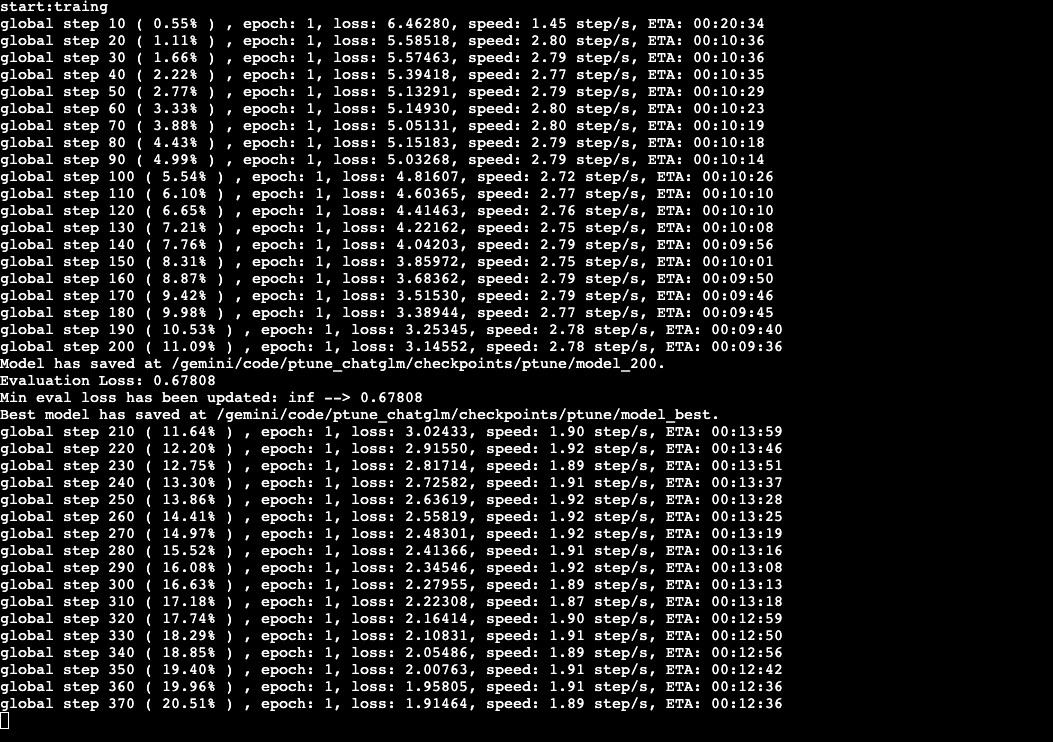
cd /Users/**/PycharmProjects/llm/ptune_chatglm
# 实现模型训练
python train.py
三、实现模型预测函数
- 目的:加载训练好的模型并测试效果
- 代码路径:/Users/**/PycharmProjects/llm/prompt_tasks/ptune_chatglm/inference.py
- 导入必备的工具包
import time
import torch

from transformers import AutoTokenizer, AutoModel
# torch.set_default_tensor_type(torch.cuda.HalfTensor)
def inference(
        model,
        tokenizer,
        instuction: str,
        sentence: str
    ):
    """
    模型 inference 函数。

    Args:
        instuction (str): _description_
        sentence (str): _description_

    Returns:
        _type_: _description_
    """
    with torch.no_grad():
        input_text = f"Instruction: {instuction}\n"
        if sentence:
            input_text += f"Input: {sentence}\n"
        input_text += f"Answer: "
        batch = tokenizer(input_text, return_tensors="pt")
        out = model.generate(
            input_ids=batch["input_ids"].to(device),
            max_new_tokens=max_new_tokens,
            temperature=0
        )
        out_text = tokenizer.decode(out[0])
        answer = out_text.split('Answer: ')[-1]
        return answer


if __name__ == '__main__':
    from rich import print

    device = 'mps:0'
    max_new_tokens = 300
    model_path = "./llm/ptune_chatglm/checkpoints/model_1800"
    tokenizer = AutoTokenizer.from_pretrained(
        model_path,
        trust_remote_code=True
    )

    model = AutoModel.from_pretrained(
        model_path,
        trust_remote_code=True
    ).half().to(device)

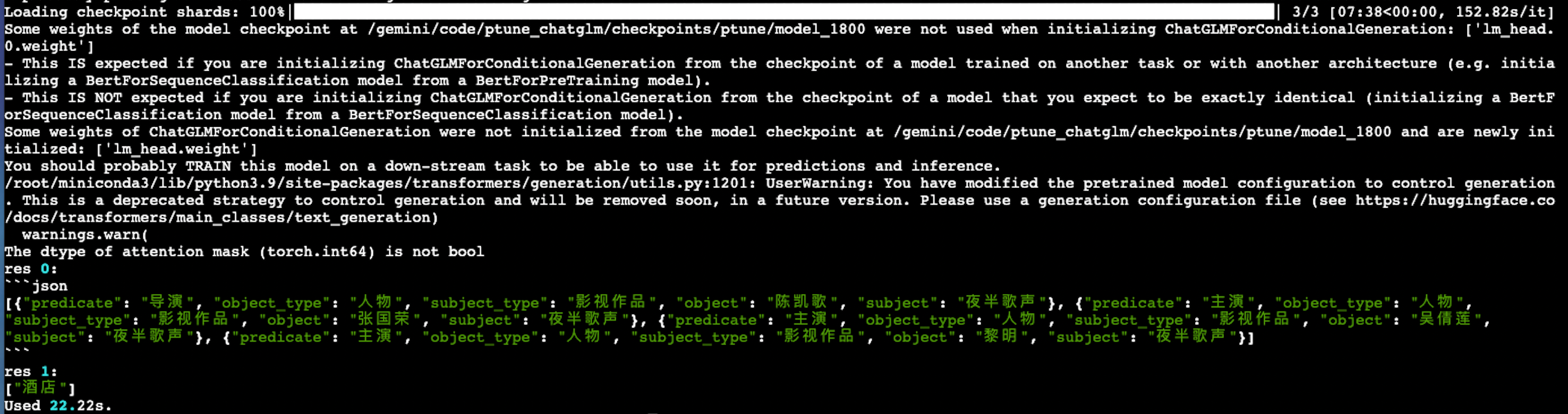
    samples = [
        {
            'instruction': "现在你是一个非常厉害的SPO抽取器。",
            "input": "下面这句中包含了哪些三元组,用json列表的形式回答,不要输出除json外的其他答案。\n\n73获奖记录人物评价:黄磊是一个特别幸运的演员,拍第一部戏就碰到了导演陈凯歌,而且在他的下一部电影《夜半歌声》中演对手戏的张国荣、吴倩莲、黎明等都是著名的港台演员。",
        },
        {
            'instruction': "你现在是一个很厉害的阅读理解器,严格按照人类指令进行回答。",
            "input": "下面子中的主语是什么类别,输出成列表形式。\n\n第N次入住了,就是方便去客户那里哈哈。还有啥说的"
        }
    ]

    start = time.time()
    for i, sample in enumerate(samples):
        res = inference(
            model,
            tokenizer,
            sample['instruction'],
            sample['input']
        )
        print(f'res {i}: ')
        print(res)
    print(f'Used {round(time.time() - start, 2)}s.')
小节总结
- 本小节实现了基于BERT+PET模型的构建, 并完成了训练和测试评估.